


Dr. Syama Prasad Mookerjee’s 125th Birth Anniversary
Syllabus: GS1/History
Context
- Prime Minister Narendra Modi paid tributes to Dr. Syama Prasad Mookerjee on his 125th birth anniversary.
Dr. Syama Prasad Mookerjee (1901- 1953)
- Initially a member of the Indian National Congress; later joined the Hindu Mahasabha in the 1930s.
- He became the youngest Vice-Chancellor of Calcutta University at age 33 in 1934.
- He served as Finance Minister of Bengal (1941–42) in the Fazlul Haq ministry.
- 1944: He founded an English daily,”Nationalist.”
- Presided over the Bilaspur session of the All-India Hindu Mahasabha.
- Met M.A Jinnah to find out a solution of Hindu-Muslim problems.
- He was a strong critic of the Muslim League and the partition of India.
- He joined the cabinet of the interim government as Minister for Industry and Supply after independence (1947–1950), but resigned over differences.
- Founder of Bharatiya Jana Sangh: In 1951, founded the Bharatiya Jana Sangh, the ideological predecessor of today’s Bharatiya Janata Party (BJP).
- Advocated for national unity, cultural nationalism, and economic self-reliance.
- Legacy: He is remembered as a staunch nationalist, educationist, and advocate of cultural unity.
- The Syama Prasad Mookerjee Port in Kolkata and several institutions are named in his honor.
Source: Mint
Hindkesari Pedgaon ‘Bailgada Sharyat’
Syllabus: GS1/ Culture
Context
- The Hindkesari Pedgaon ‘Bailgada Sharyat’ (bullock cart race) showcased Maharashtra’s deep-rooted rural sporting tradition, attracting more than 1,000 entrants and thousands of spectators from across the region.
About
- The bullock cart race is an event involving bulls or bullocks to conduct a race with the animals tied to a cart by a wooden yoke, with or without a cartman.
- The rural sport is known as ‘bailgada sharyat,’ ‘chhakadi’ or ‘shankarpath’ in the state.
- It is held annually in Pedgaon, Khatav Taluk, Satara district, Maharashtra.
Jallikattu
- Meaning: The term ‘jallikattu,’ comes from Tamil terms ‘salli kaasu’ which means coins, and kattu which means package tied to the horns of bulls as prize money.
- It is usually held during the Pongal season.
- It is a sport where men compete against each other to hold on to the humps of agitated bulls that are released into an open arena.
- Historical linkages: Jallikattu is a dated tradition. An ancient reference to bull taming is found in a seal discovered at Mohenjo-daro, which is dated between 2,500 BC and 1,800 BC.
- The sport was called Yeru thazhuval or “embracing the bull”.
Kambala
- The annual buffalo race Kambala is a unique festival observed by the farming community between November to March.
- Kambala is performed on two parallel race tracks, filled with slushy water.
- Traditionally, it is sponsored by local Tuluva landlords and households in the coastal districts of Dakshina Kannada, Udupi and Bhatkal of Karnataka and Kasaragod of Kerala, a region collectively known as Tulu Nadu.
MY Bharat (Mera Yuva Bharat)
Syllabus: GS2/ Government Initiatives
Context
- Union Minister for Youth Affairs and Sports Mansukh Mandaviya highlighted the role of MY Bharat in nurturing youth potential and directing it towards nation-building.
About MY Bharat
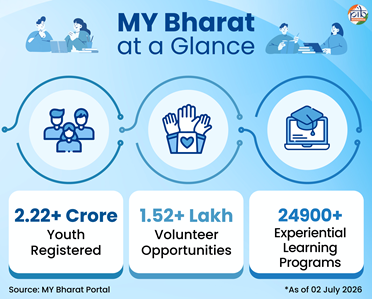
- MY Bharat (Mera Yuva Bharat) was launched in October 2023 under the Ministry of Youth Affairs and Sports as an autonomous body.
- It serves as a digital platform that connects the Government, educational institutions, non-profit organisations and industry to create meaningful youth engagement.
- It aims to place youth at the centre of nation-building by providing opportunities for volunteering, skill development, leadership, and civic participation.
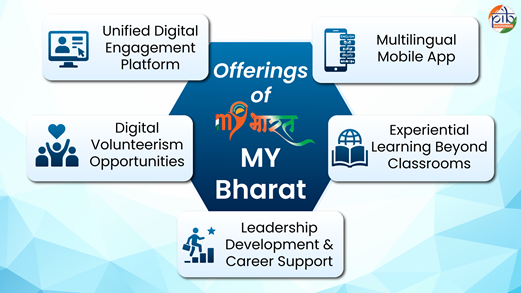
- The initiative, aligned with the National Youth Policy, primarily engages individuals in the 15–29 year age group while also nurturing adolescents between 10–19 years to cultivate early participation and civic awareness.
Source: PIB
ICC’s ‘Return to Play Post-Pregnancy’ Guidelines
Syllabus: GS2/Health
Context
- The International Cricket Council (ICC) announced a framework to assist women players who are returning to the sport after pregnancy and child birth.
About
- The Return to Play Post-Pregnancy Guidelines can be used by the Boards of member countries of the ICC to design their own policies in line with local laws for the welfare of the cricketers.
- It calls for the appointment of a case manager who will serve as the primary point of contact.
- The board recommends that players stop competing at the end of their first trimester.
- For return to play, the guidelines outline the 6 Rs framework: Ready (0-6 weeks), Review (6-8 weeks), Restore (8-16 weeks), Recondition (12-16+ weeks), Return and Refine which includes addressing social barriers such as child care, and mental well-being of the player.
- Countries having Policy: Australia, New Zealand, South Africa, England, Pakistan and the West Indies.
- India, Sri Lanka and Bangladesh do not have dedicated norms.
International Cricket Council
- The ICC is responsible for the global governance and regulation of cricket.
- It sets and enforces the rules of the game, as well as the code of conduct for players and officials.
- The ICC is headed by a Chairman, who is elected by the ICC board.
- The day-to-day operations of the ICC are overseen by the CEO.
- The ICC is governed by a board of directors comprising representatives from full member nations, with a few seats for associate members.
Source: TH
MHA lists 23 individuals as Terrorists under UAPA
Syllabus: GS2/Governance/GS3/Internal Security
Context
- The Ministry of Home Affairs has designated 23 more individuals as ‘terrorists’ under the Unlawful Activities (Prevention) Act, 1967 (UAPA).
About
- The designations were made under Section 35 of UAPA, which empowers the Central Government to add the name of an individual in the Fourth Schedule to the UAPA , if it believes that individual is involved in terrorism.
- The provision was inserted in the UAPA through an amendment in 2019.
Unlawful Activities (Prevention) Act (UAPA)
- It is India’s primary anti-terrorism law aimed at preventing unlawful activities, and terrorist activities that threaten the sovereignty and integrity of India.
- It was enacted in 1967 by the Parliament of India.
- The Central Government can designate organizations as terrorist organizations.
- Accused can be detained for a longer period without filing chargesheet up to 180 days in certain cases.
- Cases are often investigated by the National Investigation Agency.
National Investigation Agency (NIA)
- Established under: NIA Act, 2008 after 26/11 Mumbai attacks.
- Function: Central counter-terrorism law enforcement agency.
- Mandate: Investigates offences affecting India’s sovereignty, security, international treaties, etc.
- NIA (Amendment) Act, 2019:
- Jurisdiction extended: Can investigate scheduled offences committed outside India involving Indian citizens/interests.
- Expanded mandate: Covers offences under Explosive Substances Act, 1908 Human Trafficking, Cyber Terrorism Arms Act, 1959.
- Headquarters: New Delhi
- Special Courts: Total NIA Special Courts: 52
- Exclusive NIA Courts: 3 (Ranchi, Jammu and Mumbai).
Source: TH
Caged Frontier AI models
Syllabus: GS3/ Science and Technology
Context
- Recently a debate arose whether closed (caged) frontier AI models will be able to maintain their lead open-weight/open-source AI models.
What are Frontier AI Models?
- Frontier models are the most advanced AI models available at a given moment, trained on massive datasets to deliver state-of-the-art performance across many tasks, representing the leading edge of AI capability.
- They typically power advanced reasoning, image and text generation, and agentic workflows.
What are “Caged” AI Models?
- These are the frontier AI models whose model weights, training data, and architecture are not publicly released.
- Examples: OpenAI’s GPT models, Anthropic’s Claude, Google’s Gemini.
- They are controlled by the developing company and are accessible only through APIs or paid services. This allows developers to maintain safety controls, protect intellectual property, and monitor how the models are used.
- Whereas Open-weight AI models make their trained model weights publicly available, allowing anyone to download, modify, and improve them.
Source: TH
India Needs a Second Home for Asiatic Lions
Syllabus: GS3/ Environment
Context
- Recently conservation experts have reiterated the need to establish a second free-ranging population outside the Gir landscape to reduce the risk of extinction.
Why Does India Need a Second Home for Asiatic Lions?
- Population Increase: As per the 16th Lion Population Estimation, India has reported a 32% increase (from 674 in 2020 to 891 in 2025) in its lion population, exclusively concentrated in Gujarat, between 2020 and 2025.
- Potential Threat: Multiple reports of the Wildlife Institute of India have consistently emphasised that a single population confined to one landscape is vulnerable to epidemics, forest fires, or other natural disasters.
- It could wipe out the entire species if it remains geographically concentrated.
- The 2018 outbreak of the Canine Distemper Virus among the population, which killed several lions and infected many others, serves as a stark reminder of this danger.
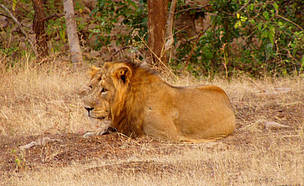
Asiatic Lion (Panthera leo persica)
- It is one of the five big cat species found in India.
- Physical Characteristics: Asiatic lions are slightly smaller than African lions.
- Males have less developed manes, leaving their ears visible.
- Prominent longitudinal fold of skin along the belly (a distinguishing feature from African lions).
- Distribution: In India, concentrated in the state of Gujarat in and around the Gir Forest mainly in;
- Gir National Park and Wildlife Sanctuary
- Paniya Wildlife Sanctuary
- Mityala Wildlife Sanctuary
- Barda Wildlife Sanctuary
- Conservation Status:
- IUCN Red List status: Endangered
- CITES: Appendix I
- Wildlife Protection Act, 1972: Schedule I
Source: TH
Previous article
AI is Reshaping Modern Warfare
